Positive Reinforcement vs Punishment Which Works Better for Dog Training

Updated: Aug 3
Quick Answer
Positive reinforcement works better for dog training because it teaches a dog what to do, not just what to avoid. It builds trust, supports learning, and turns training into a cooperative conversation. Punishment may stop a behavior in the moment, but it often creates stress, confusion, or fear, which can make learning harder.
A dog who gets rewarded for sitting, checking in, coming when called, or walking calmly has useful information. “That worked. I should try it again.” A dog who is only corrected has a much harder question to solve. “What should I do instead?”
That difference matters. Training is not just about obedience. It shapes confidence, communication, and the human-animal bond.

Training Is a Conversation, Not a Contest
Every training moment sends a message. The dog is watching, listening, smelling, guessing, and remembering. The human is doing the same, even if they do not always realize it.
Positive reinforcement says, “Yes, that choice worked.”
Punishment says, “No, not that.”
Both may change behavior, but they do not teach with the same clarity.
Dogs learn through consequences. If a behavior leads to something pleasant, such as food, play, praise, sniffing, or access to a favorite person, that behavior becomes more likely. If a behavior leads to something unpleasant or frightening, the dog may stop, but the emotional cost can be high.
The key question is not, “Can punishment suppress behavior?” Sometimes it can. The better question is, “What does the dog learn, and how does the dog feel while learning it?”
A dog who feels safe can think. A dog who feels threatened may react, shut down, avoid, or become hypervigilant. That is the difference between learning and coping.
What Positive Reinforcement Actually Means
Positive reinforcement is often misunderstood as giving endless treats or letting a dog do anything they want. In behavior science, the phrase has a specific meaning.
Positive means something is added.
Reinforcement means the behavior becomes more likely in the future.
If a dog sits and receives a treat, sitting may increase. If a dog comes when called and gets released back to sniff, coming when called may grow stronger. If a puppy settles on a mat and receives calm praise, settling becomes part of the puppy’s skill set.
This is why positive reinforcement, dog training, and clear timing fit so well together. The dog learns through information that feels safe and rewarding.
Good reinforcement is not bribery. A bribe appears before behavior and says, “Do this only if you see the prize.” A reward follows behavior and says, “That choice paid off.” Over time, rewards can shift from food every time to a mix of food, praise, play, movement, and real-life rewards.
Rewards are information
A reward is not only payment. It is feedback.
When the reward arrives at the right moment, the dog can connect it to a specific action. That is why timing matters. Rewarding three seconds late may reward jumping, sniffing, or turning away instead of the sit that happened earlier.
The clearest pattern is simple:
The dog offers or follows a behavior.
A marker word or click marks the exact moment.
A reward follows.
The marker can be a clicker, a consistent “yes,” or another short sound. It tells the dog, “That moment is the one.”
A Helpful Tool for Clearer Communication 🐾
Training becomes easier when your dog understands exactly which choice earned the reward. That is why timing and consistency matter so much during positive reinforcement training.
A treat pouch with an integrated clicker helps make those important training moments easier to capture. By keeping rewards accessible and the marker sound ready, you can communicate more clearly when your dog makes the right choice.
Why we recommend this type of training tool:
🐾 Keeps rewards available when good behaviors happen
🐾 Helps create a consistent marker-and-reward routine
🐾 Supports positive reinforcement through clear communication
🐾 Makes training sessions smoother during walks, play, and everyday learning
Remember, the tool does not train the dog—the relationship does. The purpose of training equipment is to make communication between you and your companion easier, clearer, and more rewarding.
Explore this recommended training tool →

As an Amazon Associate, LegacyPets earns from qualifying purchases at no additional cost to you
What Punishment Often Misses
Punishment focuses on reducing behavior. It may interrupt jumping, barking, pulling, or grabbing. The problem is that it rarely teaches a replacement skill.
If a dog jumps on guests and gets scolded, the dog may learn that guests predict tension. They may still not know how to greet people. Sit? Go to a mat? Hold a toy? Stay behind a gate until calm? Those are teachable behaviors.
Punishment also relies on the dog understanding which action caused the unpleasant outcome. Humans are not always precise. Dogs may connect the correction to the wrong thing.
A dog corrected for barking at another dog may not learn, “Quiet is better.” They may learn, “Other dogs make bad things happen.” That can increase anxiety around dogs.
A dog punished for growling may stop growling, but the internal discomfort may remain. Growling is communication. If the warning disappears while the fear stays, the situation can become less safe, not more safe.
This is why compassionate training pays attention to both behavior and emotion.
Dogs do not misbehave in a moral sense. They behave in ways that have worked before, meet a need, or express stress, excitement, fear, frustration, or confusion.
Appreciation Builds What Criticism Cannot
The human comparison is easy to understand. Imagine a workplace where the only feedback comes after mistakes. No one notices steady effort, good judgment, or small improvements. People become guarded. They may do the minimum needed to avoid criticism.
Now imagine a workplace where good work is seen. Effort is named. Progress is recognized. People make mistakes, but they also know what success looks like.
Dogs are not people in fur coats, but emotional learning follows a familiar pattern. Living beings tend to repeat behaviors that bring safety, connection, and reward. They also tend to avoid settings where they feel confused or threatened.
What we appreciate grows.
That lesson applies to dogs and to households. When the focus shifts from “Stop doing that” to “Here is what works,” the emotional climate changes. Training becomes less tense. The dog becomes more willing to try. The human becomes more observant.
Rewarding good behavior also changes what people notice. A calm dog lying at the doorway often gets ignored. A dog stealing a sock gets attention. From the dog’s point of view, the sock may be a brilliant strategy.
Positive reinforcement asks the human to catch the quiet wins:
Four paws on the floor
A glance back on a walk
Choosing a chew toy
Settling after excitement
Moving away from a trigger
Coming indoors when called
Waiting before going through a door
These small moments are the foundation of reliable behavior.

The Dog’s Mindset Shapes the Lesson
Training is not only mechanical. The dog’s emotional state affects learning.
A relaxed dog can notice cues, solve problems, and remember patterns. A highly stressed dog may struggle to process information. This is not stubbornness. It is biology.
When the nervous system is on high alert, survival responses can take over. The dog may pull, bark, freeze, hide, jump, mouth, or ignore known cues. In those moments, the goal is not to demand harder. The goal is to adjust the environment so learning becomes possible again.
That may mean increasing distance from a trigger, lowering distractions, using higher-value rewards, or teaching in shorter sessions.
Motivation is not the same as permissiveness
Positive training still uses structure. It includes boundaries, management, and clear expectations.
A dog who counter surfs may need food kept out of reach while they learn a mat behavior. A dog who rushes the door may need a gate while they practice waiting. A dog who pulls toward squirrels may need more distance until they can respond.
Management prevents rehearsal. Reinforcement teaches the alternative.
This is one of the most humane and practical principles in animal behavior. Do not let the unwanted behavior become the easiest path. Then reward the behavior that belongs in its place.
Better Replacements Make Better Behavior
A dog cannot do two conflicting things at the same time. They cannot jump and sit. They cannot drag forward and return to the handler. They cannot bark at the window and carry a toy to a mat with the same intensity.
That is why replacement behaviors matter.
Instead of focusing only on what to stop, choose what the dog should do.
Instead of asking for less of this | Teach more of this |
Jumping on guests | Sit, stand calmly, or go to a mat |
Pulling on leash | Check in, walk near the handler, return to position |
Barking at windows | Move to a station, find a treat scatter, settle away from the window |
Grabbing hands in play | Bite a toy, pause, or disengage briefly |
Begging at the table | Rest on a bed with a chew or food puzzle |
This approach gives the dog a path to success. It also reduces conflict because the human has a plan before the problem escalates.
Tools That Help Reward the Right Moment
Tools do not train the dog by themselves. They help the human communicate with better timing and less force. The best tools make training clearer, calmer, and more humane.
Treat pouches keep rewards ready
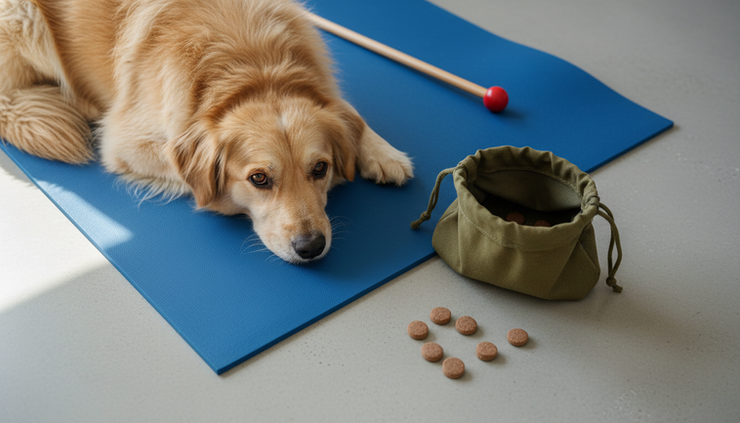
A treat pouch helps the human catch good behavior in real time. This matters because dogs connect rewards to what just happened.
Keep small, soft treats available during training walks, door greetings, recall practice, and new skill sessions. The reward does not need to be large. It needs to arrive quickly and matter to the dog.
Some dogs work well for kibble in quiet rooms but need chicken, cheese, or another high-value option near distractions. Food value should match the difficulty of the task.
Target sticks guide without pushing or pulling
A target stick gives the dog a clear physical point to follow or touch. It can help teach positions like sit, down, spin, heel position, or moving onto a mat.
The benefit is subtle but important. The dog uses their own body. No one has to push their hips down or pull them into place. This protects trust and helps the dog understand the movement.
Hand targeting works the same way. Teaching a dog to touch their nose to a palm can become a gentle way to move them, redirect them, or help them focus.
Long leashes support freedom and safety
A long leash gives the dog room to sniff and explore while still staying connected. It is especially helpful for recall practice in open areas where off-leash freedom is not safe or allowed.
The human can reward check-ins, name response, and coming when called. The dog learns that returning does not always end fun. Sometimes it leads to food, praise, and then more exploring.
That lesson builds a stronger recall than repeated calling when the dog is already out of reach.

A Simple Framework for Choosing Reinforcement
A reward only reinforces behavior if the dog values it in that moment. Praise may be enough in the kitchen. It may not compete with deer scent on a trail.
Think of rewards in categories:
Food
Small treats, kibble, fresh food rewards, or lickable treats
Play
Tug, fetch, chase games, or toy access
Environment
Sniffing, moving forward, greeting a safe person, exploring a patch of grass
Social connection
Calm praise, touch if the dog enjoys it, shared attention
Relief
More distance from something stressful, a quiet break, or a chance to disengage
Relief is often overlooked. For a nervous dog, moving away from a trigger can be deeply reinforcing. That does not reward fear. It teaches the dog that they can trust the human to help them stay safe. Over time, that trust can create the conditions for calmer behavior.
What to Do When a Dog Makes the Wrong Choice
Positive reinforcement does not mean ignoring every problem. It means responding in a way that protects learning.
When a dog makes an unwanted choice, pause and ask three questions.
What was the dog trying to get or avoid?
Behavior has a function. The dog may want food, attention, distance, movement, play, or relief.
What made the behavior possible?
Food on the counter, a loose leash near a squirrel, an open front door, or too much excitement can set the dog up to fail.
What can be taught instead?
Choose a replacement behavior and practice it when the dog can succeed.
For example, if a dog barks at passing people through the window, the first step may be closing blinds or using window film during high-traffic times. Then teach a cue such as “find it,” with treats scattered away from the window. Later, reward quiet glances and voluntary disengagement.
The dog learns a new pattern. See person, move away, collect food, settle. That is more useful than simply hearing “no” after the barking starts.
When Training Needs More Support
Some behaviors need professional help, especially if they involve intense fear, repeated lunging, guarding, bites, panic, or sudden behavior changes. A veterinarian can check for pain or medical factors. A qualified reward-based trainer or veterinary behavior professional can design a plan that fits the dog’s needs.
Pain and stress can look like disobedience. A dog who suddenly resists handling, avoids stairs, growls when touched, or becomes reactive may not need firmer training. They may need care, assessment, and a slower plan.
This is where dog psychology and dog wellness overlap. Behavior lives in the body. Sleep, pain, diet, enrichment, exercise, genetics, learning history, and household stress can all influence how a dog responds.
Training works best when the whole dog is considered.
Positive Reinforcement Builds a Dog Who Wants to Try
The strongest training is not built on control. It is built on communication.
A dog trained with rewards learns that human cues can lead to good outcomes. They learn that offering calm behavior is worthwhile. They learn that checking in pays. They learn that the human is a safe source of information.
This does not create a spoiled dog. It creates a dog with a history of success.
Punishment may create quick silence, stillness, or hesitation. Positive reinforcement creates understanding. That is the lasting advantage.
A well-trained dog is not one who fears being wrong. A well-trained dog is one who has practiced being right so often that good choices become familiar.
Positive reinforcement works because it teaches the dog what to do while protecting the trust that makes learning possible. Keep rewards ready, catch the good, and build skills one clear moment at a time. Continue exploring the foundation of humane learning in the Behavior & Training Pillar Hub.


Comments