Behavior Is Communication How to Understand Your Pets Needs

Direct Answer
Your pet behaves that way because behavior is communication.
A dog who barks, a cat who hides, a puppy who chews, or a senior pet who becomes restless is not being difficult for the sake of it. They are responding to something they feel, need, fear, expect, or have learned.
Empathy begins when behavior stops looking like defiance and starts looking like information.
A calmer response does not mean allowing every behavior to continue. It means pausing long enough to ask better questions:
What need might this behavior be meeting?
What emotion might be driving it?
What has my pet learned works in this situation?
What can change in the environment, routine, or training plan to help them succeed?
That shift sits at the heart of the human-animal bond and good pet education. It asks the human to grow in awareness, timing, patience, and skill so the animal can feel safer, learn more easily, and live with less stress.

Behavior is Communication Before the Story We Tell About It
Pets communicate all day, often in ways people miss.
A dog turns their head away. A cat flicks their tail. A rabbit freezes. A senior dog paces after dinner. These are messages, not moral choices.
Some messages are easy to welcome, such as a loose body, soft eyes, a play bow, a slow blink, or a relaxed stretch. Others feel harder to receive, especially when they interrupt sleep, damage furniture, or create tension at home.
Still, the behavior has a function. It does something for the animal.
A bark may create distance from a stranger. Chewing may soothe a puppy’s sore gums or restless body. Scratching a sofa may mark a familiar place with scent and texture. Hiding may help a cat feel safe. Jumping may bring attention, even if that attention sounds like “Stop!”
When humans call these behaviors “bad,” they often miss the message underneath.
The better question is not “How do I stop this?” The better question is “What is this behavior doing for my pet?”
That question opens the door to clearer training, gentler care, and stronger trust.
The Same Behavior Can Mean Different Things
One of the most common misunderstandings in companion animal care is assuming one behavior always has one meaning.
Barking is a good example.
A dog may bark because they are afraid, excited, frustrated, bored, startled, or trying to alert the household. The sound may look similar from the outside, but the inner experience can be very different.
The same is true for cats who scratch, dogs who pull on leash, birds who scream, or pets who refuse to come when called.
A behavior gains meaning from context.
Look at what happened before and after:
What was happening in the room?
Who entered or left?
What sound occurred?
Was food, play, rest, or access involved?
Did the behavior make something start?
Did the behavior make something stop?
Did the person respond in a way the animal may repeat?
This is where behavioral science becomes practical. Animals learn through patterns. If a behavior helps them gain something they value or avoid something they find uncomfortable, that behavior is more likely to appear again.
That does not make the pet manipulative. It makes the pet a learner.
Behavior is information. The more carefully we read it, the more kindly and effectively we can respond.
Emotional Regulation Begins With the Human
A pet’s behavior can stir strong feelings.
A barking dog may make the body tighten. A scratched chair may trigger frustration. A cat hiding for days may create worry. A lunging walk may bring embarrassment before the leash is even clipped on.
Those feelings are real. They deserve care too.
But animals learn better when the human nervous system is steady enough to guide them. Emotional regulation is not pretending to be calm. It is noticing the rise of stress early and choosing a response that does not add fear or confusion.
Before correcting, moving closer, calling louder, or reaching in, pause.
Try this simple sequence:
Soften your body
Drop your shoulders. Unclench your hands. Loosen the leash if it is safe to do so.
Lower your voice
A quieter voice often carries more useful information than a louder one.
Create space
Distance can help an animal think. Step back from the trigger, block visual access, or guide the pet to a calmer area.
Name what you see
Use plain observation. “Tail tucked.” “Ears back.” “Staring at the door.” “Chewing the table leg.”
Choose one helpful next step
Give a cue the pet knows, offer a safe chew, scatter food, close the curtain, or end the interaction.
The goal is not perfection. The goal is recovery. Each time the human recovers sooner, the pet gets a clearer teacher.
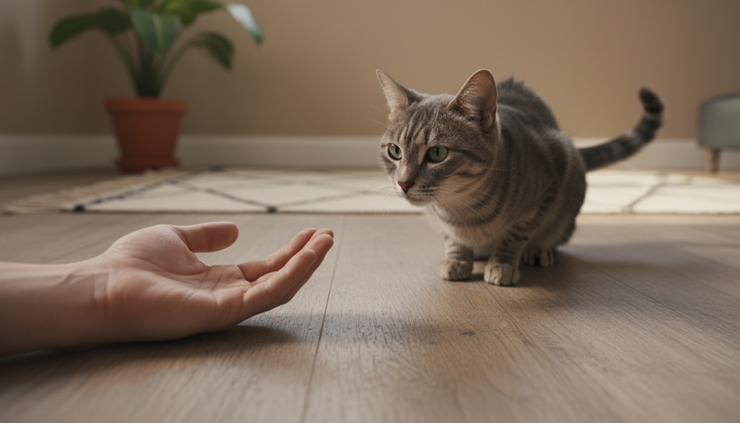
Ask What Need the Behavior Is Meeting
Most behavior grows from a need, a feeling, or a learning history. Often, it grows from all three.
A puppy who steals socks may need movement, chewing, attention, or a better way to explore. A cat who wakes the household at 4 a.m. may have learned that early vocalizing creates breakfast. A dog who barks at the window may feel pressure from passersby and relief when they disappear.
Instead of responding only to the visible behavior, look underneath it.
Needs that often sit under behavior
Common needs include:
Safety
Predictable routines
Rest
Movement
Food and foraging
Social connection
Choice
Mental engagement
Comfortable distance from something worrying
A legal outlet for natural behavior
“Legal outlet” means a safe, approved version of what the animal already needs to do.
A dog who digs may need a digging spot. A cat who scratches needs stable scratching surfaces. A parrot who shreds needs safe shredding materials. A young dog who mouths needs appropriate chew items and calm teaching.
Meeting the need does not reward “bad behavior.” It reduces the pressure that keeps producing the behavior.
Change the Environment Before You Ask for Better Choices
Training matters. The environment matters first.
If a dog barks at every person passing the front window, start with the window. Use curtains, film, gates, or a different resting place. If a cat jumps on the counter for food scraps, clear the counter and feed before meal prep. If a puppy chews shoes, put shoes away and offer chew options where the puppy spends time.
This is not giving up. It is teaching from a cleaner starting point.
A stressed animal has less room to learn. A prepared environment lowers the difficulty.
Think of it as removing static from the conversation.
Once the environment supports the pet, the human can teach the desired behavior with better timing and less conflict.
For example:
Reward the dog for looking at a passerby and turning back.
Reward the cat for using the scratching post.
Reward the puppy for choosing a chew toy.
Reward the bird for calm vocal sounds before screaming begins.
Reward the rabbit for moving into a carrier on their own.
Positive reinforcement works because it makes the desired behavior worth repeating. It does not require force, fear, or intimidation. It simply gives the animal clear feedback: “That choice worked.”
Learn the Early Signals
Many people notice behavior only when it becomes loud.
The bite. The bark. The swat. The growl. The accident. The shredded cushion.
But animals usually speak more softly first.
A dog may lick their lips, yawn, turn away, slow down, stiffen, or avoid eye contact. A cat may crouch, flatten their ears, twitch their tail, or shift weight backward. A small pet may freeze, hide, thump, or refuse food in a tense moment.
These early signals are gifts. They give humans time to help before the animal feels pushed into a bigger response.
When those early signals work, pets do not need to escalate as often.
This matters deeply for pet wellness. A home where small signals are noticed becomes a safer place to communicate. The animal learns that they do not have to shout to be heard.

Replace Control With Clear Teaching
Control often asks, “How do I make my pet stop?”
Communication asks, “What can I teach instead?”
That question changes everything.
A dog jumping on guests can learn to stand on a mat. A cat scratching a chair can learn that a tall sisal post feels better and earns attention. A dog pulling toward another dog can learn to check in with their person at a distance where thinking is still possible.
Teaching a replacement behavior works best when it meets three conditions:
It is easy enough to do
Do not start in the hardest version of the situation.
It meets a real need
A pet needs another path to safety, attention, movement, or relief.
It pays well
Use food, play, distance, access, sniffing, or gentle praise, depending on what the animal values.
The replacement must be taught before the difficult moment whenever possible. Waiting until the pet is overwhelmed makes learning harder.
A good training plan feels almost too simple at first. That is a sign the animal has room to succeed.
A Four-Step Way to Read Behavior More Clearly
When a behavior feels confusing, use this steady process.
1. Describe only what a camera would see
Avoid labels like stubborn, spiteful, jealous, dramatic, or guilty.
Use observable words.
“The dog barked three times when the delivery person approached.”
“The cat ran under the bed when the child entered the room.”
“The puppy chewed the chair leg after thirty minutes of active play.”
This keeps the mind open.
2. Notice what came before
Look for triggers and patterns. Time of day matters. So do sounds, movement, hunger, fatigue, visitors, routine changes, and access to favorite things.
The “before” often holds the key.
3. Notice what happened after
Did the pet gain attention? Did the scary thing move away? Did the door open? Did food arrive? Did play begin? Did the human chase?
The “after” tells you what the behavior may be teaching the animal.
4. Change one thing and watch
Do not overhaul everything at once. Change one part of the setup and observe.
Move the bed away from the window. Feed earlier. add a sniff walk. Practice the cue in a quieter room. Offer a scratching post near the sofa. Give the senior dog a predictable evening routine.
Small changes reveal useful truths.
When Behavior Changes Suddenly
Sudden behavior changes deserve careful attention.
If a social pet begins hiding, a house-trained pet starts having accidents, a gentle animal growls when touched, or a senior pet becomes restless at night, do not assume the issue is “just behavior.”
Comfort, pain, sensory changes, stress, and changes in the home can all affect how animals act. A trusted veterinarian can help rule out physical causes while a behavior plan supports daily life.
This does not make the animal broken. It means the body and behavior are connected.
A wise response holds both possibilities with care.

What Better Communication Looks Like Over Time
Progress may look quiet.
The dog barks once instead of ten times. The cat watches from the doorway instead of hiding under the bed. The puppy chooses a chew toy twice in one afternoon. The senior pet settles sooner after dinner. The human notices a tight body before the growl appears.
These are not small things. They are signs of safety returning to the relationship.
Better communication grows through repeated moments:
The human pauses before reacting.
The environment becomes easier to navigate.
The pet gets rewarded for behaviors worth repeating.
Natural needs receive safe outlets.
Early signals are respected.
Training becomes a conversation instead of a contest.
A pet does not need a perfect human. A pet needs a human who keeps listening, keeps learning, and repairs when a moment goes poorly.
Behavior will always carry messages. Some will be joyful. Some will be inconvenient. Some will ask for patience that stretches the heart.
The work is to listen before judging, teach before demanding, and guide without fear.
When behavior becomes information, the relationship becomes kinder. And in that kindness, learning has room to take root.

Comments